
After 45, muscle is the retirement account
July 25, 2026

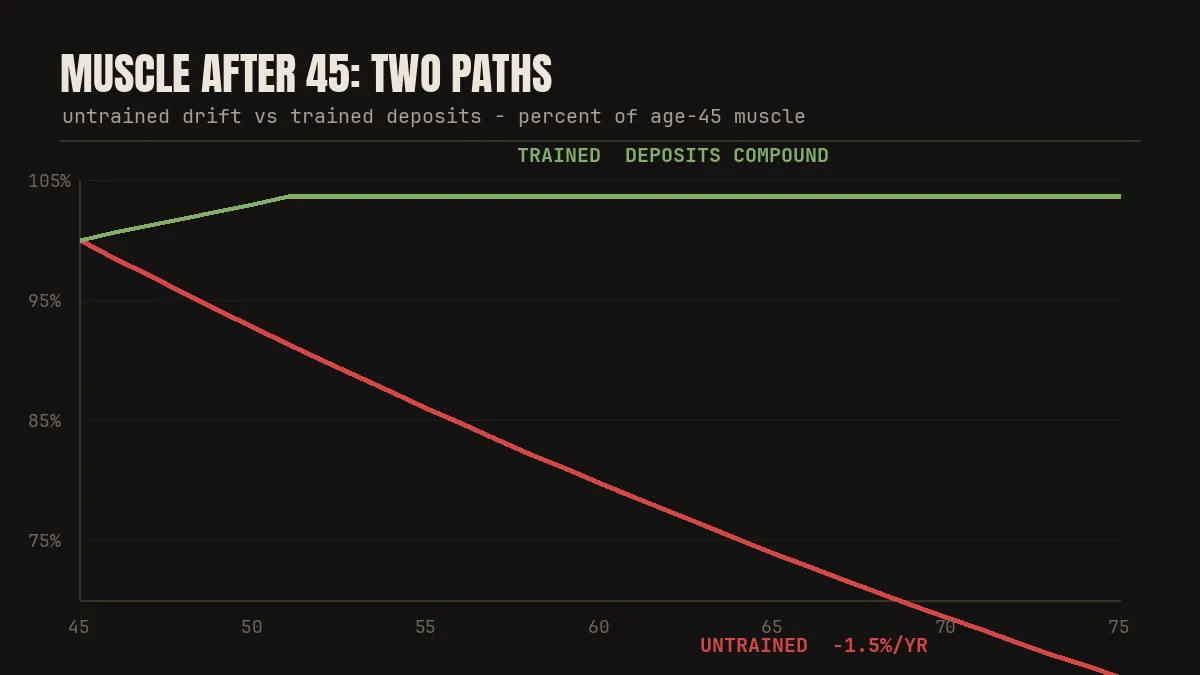
Here is the math nobody puts on a birthday card: untrained, men lose roughly 1-2% of their muscle per year after 45. Tendons get less elastic, joints tolerate less abuse, sleep drives more of your recovery, and bone density begins its long decline.
That part is real, so we do not pretend otherwise. Here is the part that matters more: the ability to gain strength and muscle with training does not go away. The response is slower than at 25. It is not absent.
Most men over 45 do not have a fitness problem. They have a frame problem. They think of exercise as paying a tax on the weekend's food, or as a fight against decline they are slowly losing. Both frames make training feel optional, and optional things get skipped. This post gives you the frame that makes training feel like what it actually is: the single highest-return habit available to you for the next thirty years.
Why this shows up as belly fat and the 3 p.m. crash first
Muscle is not just what moves you. It is the engine that burns fuel all day, the single biggest chunk of your resting metabolism, and it is the tissue that soaks up blood sugar after meals. Lose it steadily for a decade and three things follow: the waistline creeps even when nothing about your eating changed, the energy dips arrive earlier, and the blood-work conversation with your doctor gets more interesting.
This is why the symptoms men over 45 Google - belly fat, tiredness, joint complaints, a pre-diabetes warning - so often share one root cause. They are not five separate problems. They are what a slow muscle shortage looks like from the outside.
That is also why diets alone keep failing men in this age group. You can restrict food and lose weight, but if some of that weight is the engine itself, you end up lighter, softer, and hungrier, with a metabolism that burns less than before. The scale moves. The problem does not.
Run the numbers on a decade. Lose a pound of muscle a year - the slow end of the range - and by 55 you are carrying ten pounds less engine than at 45. Ten pounds of muscle burns on the order of a couple of hundred calories a day just by existing. That is the difference between the waistline that holds and the waistline that creeps, with no change in diet required to explain it.
The 3 p.m. crash has the same root. Muscle is where most of the glucose from your lunch is supposed to go. With less of it, blood sugar rides higher after meals and falls harder after, and the fall is the crash you feel at your desk. Men treat it with caffeine. The fix is upstream.
The frame that makes it click
Strength and bone are the retirement account. Every workout is a deposit: small, regular, compounding. You are not managing decline. You are funding the body you want at 65, 75, and beyond.
Men in their 50s and 60s who train with gradually increasing weights keep building. The research and every gym floor agree. The difference between the man who carries his own luggage at 75 and the man who cannot is not genetics. It is deposits.
And like a retirement account, the math rewards starting now over starting perfectly. Two workouts a week, done for a year, beat the heroic plan that lasts six weeks. If that arithmetic sounds familiar, it should: it is the same math behind why two days done beats five days planned (/blog/two-days-done-beats-five-days-planned).
The frame also explains the compounding asymmetry. Every deposit is small and unremarkable - a forty-minute workout nobody would photograph. But deposits do not add, they compound: stronger legs make the next workout better, the better workout builds more muscle, the extra muscle burns more fuel and protects more bone, and the whole loop runs again next week. The man ten years in is not ten times one year in. He is on a different curve entirely.
And the frame kills the two questions that stall men at the start. How fast will I see results is the wrong question - you do not check a retirement account daily. Am I too old to start is the wrong question - the account does not care when you opened it, only that deposits are arriving now.
What a deposit actually looks like
Not two-hour gym sessions and not bodybuilding. The deposit that compounds is two to four full-body workouts a week, built on the big patterns - squat, hinge, push, pull, carry - at an effort that is challenging but controlled. Each session sends the keep-the-muscle signal that the 1-2% annual loss depends on you not sending.
Protein rides alongside: 30-40 grams per meal, because older muscle needs the full dose each time. The training provides the signal; the protein provides the material. Neither works well alone. The full rule, including what it looks like on an actual plate, is in protein after 45: the per-meal rule (/blog/protein-after-45-the-per-meal-rule) and the nutrition guide (/nutrition).
Bone gets paid too. Muscle pulls on bone every time it contracts under load, and that pull is exactly the signal bone needs to keep its density. There is no supplement that replicates it. The specifics are in bone density: the 90-second habit (/blog/bone-density-the-90-second-habit).
Notice what is not on the list: no split routines with a day per body part, no two-hour sessions, no exhaustion as a goal. The patterns are trained together because that is how the body uses them, and the effort is capped because a deposit you cannot recover from is a withdrawal wearing a costume.
The full deposit template - exercises, sets, effort rules, and how the weights rise - is laid out step by step in the guide (/guide).
The three ways men break the account
The first is grinding: chasing personal records and max tests with a 45-year-old recovery budget. The muscle-building signal does not require it, and the injury risk is where accounts go to die. Every set in this program stops two reps short of failure, and the reasoning is laid out in why grinding is banned (/blog/two-reps-short-why-grinding-is-banned).
The second is the all-or-nothing trap: miss a week, decide the streak is broken, stop entirely. A retirement account does not care that you skipped a deposit in March. It cares that you kept making them for thirty years. The program is built around this, which is why the rough-week rule (/blog/the-rough-week-rule) scales your training down on bad weeks instead of punishing you for them.
The third is treating sleep as optional. After 45, sleep is when the deposit actually lands: it drives recovery, hormones, and appetite regulation. Short-change it and you are making withdrawals while thinking you are saving. The mechanics are in sleep drives the program (/blog/sleep-drives-the-program).
A fourth breaker deserves naming because it is the most common: waiting for the right time. Next month, after the project, when work calms down. The account does not charge a penalty for waiting - it just quietly pays out less, at 1-2% a year, forever. The start date is the only variable fully in your control, and it is the one the account prices highest.
What changes is the rules, not the goal
After 45, recovery changes the rules. The program that works is the one that respects that: joint-friendly exercises, every set stopped short of failure, lighter weeks built in, and a plan that eases off when your sleep or energy says to.
It is not easier exercise. It is the same training effect, delivered with recovery and joints designed in from the start, so you are still making deposits in five years instead of nursing what broke in month two.
The goal is not a beach body or a number on a bar. The goal is the account: strong legs that get you off the floor at 80, bone that survives a fall, an engine that keeps your bloodwork boring. That account is built one unremarkable workout at a time.
The balance sheet at 65 and 75
It helps to make the account concrete, because the payoff happens in decades, not mirror-checks. The strength research on aging is blunt about what the balance buys: leg strength in your 60s and 70s predicts whether you live independently, whether a fall is a bruise or a fracture, and whether you can climb stairs, carry groceries, and get up off the floor without planning it.
Grip strength shows up in study after study as one of the strongest single markers of healthy aging - not because grip itself matters, but because it is the honest readout of a body that has kept its muscle. You cannot fake grip strength with a good week. It is the account balance, visible in one squeeze.
None of this requires becoming an athlete. It requires refusing the default. The default after 45 is a slow liquidation - 1-2% a year, unnoticed until the day it is very noticed. The alternative is a deposit schedule so modest it fits around a job and a family. That is the entire choice, and it is made weekly, not once.
Why the fitness industry sells you the wrong account
Most programs aimed at men over 45 are built on one of two errors. The first borrows from 25-year-old bodybuilding: high volume, daily sessions, grind every set. It produces soreness, then injury, then a man who concludes he is too old for this. He was not too old. The program was too stupid.
The second error borrows from senior-citizen aerobics: pink dumbbells, machines only, never progress the weight. This one fails more politely - it is safe, pleasant, and sends a signal too weak to build anything. The account gets no deposits, just maintenance fees.
The correct program sits exactly between: real weights, real progression, joint-friendly exercise choices, effort capped short of failure, and recovery treated as part of the plan. It is less exciting than the first option and more demanding than the second. It is also the only one that works for decades.
The objection: 'I don't want to get bulky'
Every coach who works with men over 45 hears this, usually from men who have never once accidentally gained muscle. Building muscle after 45 is slow, deliberate work - you will not trip and wake up bulky. The men you see who look too big spent years and often chemistry getting there.
What you will actually notice, in order: you feel stronger within weeks, your posture and energy change within a couple of months, your clothes fit differently within a season. The mirror lags the logbook by months. Trust the logbook.
And if bulk is truly not the goal, the same training still applies - muscle is the engine regardless of how much of it you display. The deposit is the same; the body decides the packaging.
The objection: 'I don't have time'
The account does not ask for much time. It asks for regular time. Two sessions a week of forty to fifty minutes is under two hours - less than a single round of golf, less than a weekend of sports on the couch.
The men who genuinely cannot find two hours a week have a scheduling problem worth solving, because the alternative schedule is the one where health appointments start claiming the time instead. The deposits happen now, on your calendar, or the withdrawals happen later, on someone else's.
If the week truly collapses, the program scales down rather than breaks - that is the rough-week rule (/blog/the-rough-week-rule) - and even the scaled version keeps the account open. Zero is the only real threat to the balance.
What the first year actually looks like
Months one to three are the quiet phase. The mirror shows almost nothing, which is where most men quit programs. What is actually happening: the nervous system is learning the movements, the habit is forming, sleep is often already improving, and the logbook - not the mirror - is where the evidence lives. Strength climbs fastest in this phase, and it is real.
Months four to eight: clothes start telling the truth. The belt moves a notch, the shoulders fill a shirt differently, someone you have not seen in a while says something. Energy through the afternoon is noticeably steadier - the 3 p.m. crash is fading, because the engine is bigger.
Months nine to twelve: the account becomes visible. The strength checks show numbers you would not have believed in month one, the midsection conversation has changed (/blog/what-actually-changes-the-midsection), and - the part men do not expect - training has quietly become something you do rather than something you are trying to do. That identity shift is the year's biggest yield.
The account pays in four currencies
Strength is the obvious one: legs, back, grip, the ability to move your own body and the world's objects without negotiation. But it is only one of four.
Metabolism is the quiet one: more muscle means more fuel burned at rest and better blood-sugar handling after every meal, which is why the belly and the crash respond to training before they respond to any diet.
Bone is the sleeper: the same sessions that build muscle load the skeleton, and the skeleton answers with density (/blog/bone-density-the-90-second-habit). You will never feel this one working. You will only ever feel it if it was not working.
Reserve is the one nobody prices until they need it: muscle is literally the body's savings account for illness and injury. The man who enters a surgery or a bad flu with ten extra pounds of muscle draws it down and recovers. The man without it starts from zero. Doctors see this difference in recovery rooms every day.
Why 'maintaining' is not a real option
Men often ask whether they can just maintain what they have. Physiologically, maintenance is a myth: the body keeps what it is asked to keep and releases the rest. A muscle that is never challenged is a muscle the body is slowly selling off - that is what the 1-2% annual loss is.
The good news inside that fact: the ask does not have to be heroic. The keep-and-build signal is two to four honest sessions a week with weights that rise slowly over time (/blog/the-smallest-jumps-available). You are not choosing between bodybuilding and decline. You are choosing between a modest, sustainable ask and a quiet liquidation.
The account and the doctor's office
Every marker your doctor tracks after 45 sits downstream of this account. Blood sugar: muscle is the main customer for glucose. Blood pressure and cholesterol: moved by training and the engine work around it (/blog/cardio-without-the-punishment). The weight conversation: a body-composition story, not a scale story.
Men who train often watch their annual bloodwork change conversation by conversation - not because of a pill, but because the underlying machinery improved. That is not a claim to bring to your doctor as proof. It is a trend to bring as data, and it is one of the most motivating scoreboards the account offers.
How the account handles an interruption
Life will interrupt the deposits - a surgery, a busy quarter, a long trip. The account handles interruption better than any other investment you own: muscle has memory. Strength lost during a layoff returns in a fraction of the time it took to build, because the adaptations you banked leave the machinery ready to rebuild.
The protocol after any break is the same: return at reduced load, take the smallest jumps back up (/blog/the-smallest-jumps-available), and let the rough-week rule (/blog/the-rough-week-rule) carry the first fortnight. No guilt sessions, no doubling up to catch up. The account does not punish the interruption - it just resumes compounding the moment the deposits restart.
The weekly rhythm that funds everything
Put the whole system together and a funded week looks unremarkable: two to four lifting sessions under an hour each, one or two easy engine sessions (/blog/cardio-without-the-punishment), ninety seconds of bone work daily (/blog/bone-density-the-90-second-habit), anchored meals (/blog/protein-after-45-the-per-meal-rule), and sleep defended like it matters, because it does (/blog/sleep-drives-the-program).
Total extra hours: fewer than most men spend watching sport. Total return: the only account that pays out in independence. Every post on this site is a footnote to that sentence.
Start where you stand
The account does not care about your opening balance. Never lifted: the smallest loads teach the patterns and the account opens. Years away from it: muscle memory means your balance rebuilds faster than a beginner's. Already training but grinding and stalling: the rules here - effort capped, jumps small, recovery respected - are the upgrade, not a restart.
Wherever you stand, the first deposit is the same size: small, this week, repeatable. The guide (/guide) has the exact first two weeks. The account opens the day the first deposit lands, and not before - which is the only argument for today over someday.
One promise about what you will not find here: no before-and-after countdown, no thirty-day shred, no claim that this is fast. The account pays in decades, and the honesty about that is what makes the weekly ask so small. Small enough to start today, and small enough to still be doing when today is five years ago.
Do this today
Pick your two days. Not five, not when things calm down. Two specific days this week with a time attached to each.
Then do one honest thing: a set of squats to a chair, slow on the way down, standing back up without using your hands. Stop when it stops being crisp. That number, whatever it is, is your current balance. It only goes one of two directions from here, and you get to pick which.
When you are ready for the full system - the joint-friendly exercise picks, the two-reps-short rule, the plan that reads your rough weeks - the complete guide is here (/guide).
Start your first two weeks this week.
Full workouts, check-ins, workouts that adjust to you. Free - no card required.
Start free