
The rough-week rule: how the plan reads your recovery
August 5, 2026

After 45, sleep and stress drive more of your training outcome than any program detail. A brutal work week, a sick kid, a string of five-hour nights: a spreadsheet plan does not know any of that, and it will happily break you anyway.
So the program asks instead of assumes. Every session includes a quick check-in on sleep, energy, and protein - and the plan changes based on your answers. This post is the rule, why it exists, and why it is the feature that separates a program you survive from a program that survives you.
The rule, in one sentence
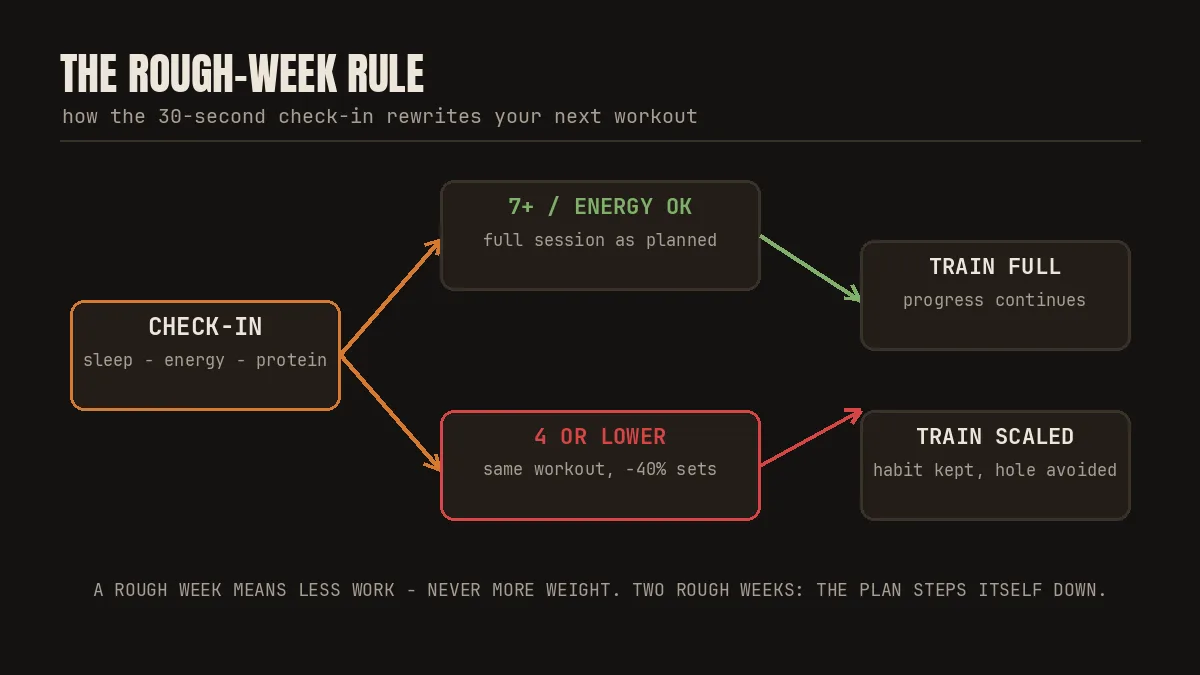
Sleep 4 out of 10 or energy 4 out of 10, and your next workout keeps the same exercises and weights but drops about 40% of the sets. A rough week means less work. Never more weight.
Two flagged weeks in a row and the program steps itself down before you break. You do not have to make the call, and you do not have to feel guilty about it. The adjustment is the plan working, not you failing it.
The rule has a quiet second half: when sleep and energy are good, nothing changes either. No bonus sets, no celebratory jumps. Good weeks earn the normal plan. Rough weeks earn less work. More weight comes on schedule, in the smallest jumps available (/blog/the-smallest-jumps-available), never as a mood.
Why 40% and not zero? Because zero is where habits die, and the evidence on habit formation is consistent: the behavior has to happen to stay alive, even in miniature. A scaled session keeps the appointment, the warm-up, the movement patterns, and the identity of a man who trains - at a cost a rough week can pay.
What a scaled day looks like
Same warm-up. Same exercises. Same weights on the bar. The only thing that changes is the dose: three sets become two, or two sets become one. You are in and out in about half the usual time, and you leave feeling better than you arrived.
This matters more than it sounds. The habit that actually builds the retirement account (/blog/muscle-is-the-retirement-account) is showing up, and showing up survives a scaled day. It does not survive a skipped one, because skipped days cluster: one becomes three, three becomes a month, and a month becomes starting over.
A scaled workout keeps the chain unbroken and still sends the keep-the-muscle signal. It is not a consolation prize. Physiologically, it is most of the benefit at a cost your rough week can afford.
There is a psychological dividend men do not expect: the scaled day often turns into a decent day. Arriving depleted and moving through a light session frequently lifts energy rather than draining it - the body reports back better than the brain predicted. You leave with more than you brought, which never happens on the couch.
Why willpower is the wrong tool for this
Most programs implicitly assume you will push through bad weeks on discipline. That works at 30 for a while. At 50, pushing through a rough week does not make you tough. It makes you injured or sick, and then the program is over anyway.
Willpower is also a terrible sensor. Men who have spent decades powering through are the worst judges of when to back off. The check-in replaces judgment with a rule: the number says 4, the volume drops, no negotiation with yourself required.
This is the same logic behind why grinding is banned (/blog/two-reps-short-why-grinding-is-banned). The program does not trust mood - neither the heroic kind nor the discouraged kind. It trusts the check-in and the logbook.
Why this is the feature that matters
Ask men who quit training in their 40s and 50s why they stopped, and you almost never hear the exercises were too hard. You hear: work got busy, I got sick, I tweaked something, I fell off and never got back on. Every one of those is a rough-week failure, not a fitness failure.
Life after 45 is not a calm sea. It is a job with quarters, parents with appointments, kids with crises, a body that occasionally just says no. A program that only works in a calm sea is a program that does not work.
The rough-week rule is what makes the plan survivable for a man with a life. It is also, not coincidentally, what makes two days a week enough (/blog/two-days-done-beats-five-days-planned): when the plan flexes with your life instead of fighting it, you stop needing to restart.
It is also the feature no static plan can imitate. A PDF cannot know you slept four hours. A spreadsheet cannot see that work exploded. The gap between a plan and a program is exactly this: a program has a sensor, a rule, and a human reading the trends - and it changes in response to you.
The check-in is thirty seconds, and a coach reads it
The check-in is three quick ratings: how you slept, how your energy is, whether you hit your protein. No essays, no tracking apps, no food photography.
Those answers do not go into a void. A coach reads the trends. Two rough weeks in a row, a stalled lift, a pattern of bad sleep - that is a human looking at your situation and adjusting the plan, not an algorithm serving the next template. Sleep, especially, moves everything; the specifics are in sleep drives the program (/blog/sleep-drives-the-program).
The result is a program that behaves like a sensible training partner: it notices when you are running on empty and it never punishes you for it.
The three rough-week archetypes
The work ambush: quarter-end, a launch, a boss with a deadline. Sleep shortens, stress climbs, training time shrinks. The rule's answer: scaled sessions, short ones, no progression. The week passes, the habit survives, and the following week resumes at full volume as if nothing happened - because physiologically, nothing was lost.
The illness: the cold going around the house finds you. The rule here is simpler - a real illness means rest, full stop, and the program treats the return like a scaled week automatically. The old instinct to sweat it out is retired; training through illness after 45 is how a cold becomes three weeks off.
The mystery flat week: nothing happened, you are just flat - poor sleep for no clear reason, energy in the basement. This is the week men most often force, and the week the rule is most valuable: two scaled sessions later, the flatness usually passes without ever becoming a layoff. The body was asking for a deload. The rule gave it one on schedule.
What happens on the other side
The part that surprises men: progress does not stall across a rough week. Muscle and strength are protected by the scaled sessions, and the recovery debt that would have been collected by forcing full training never gets charged. Men come back the following week and lift the same or more - having done less.
Over a year, the arithmetic compounds quietly. The man with the rule loses perhaps two or three weeks of full volume to life's weather. The man without it loses two or three months to the injury, the burnout, or the restart. Same program, same man - the rule is worth a quarter of the year's training.
The check-in as a conversation
The three ratings are short on purpose - thirty seconds, no journaling homework - but they add up to something a spreadsheet never had: a record of how training intersects with your actual life. Weeks in, the pattern becomes visible. Poor sleep clusters on certain nights. Energy dips after certain weeks. That visibility is how the four sleep levers (/blog/sleep-drives-the-program) get aimed at the right target.
Why the rule says 'never more weight'
The half of the rule men question is not the scaling down - it is the prohibition on adding weight during a flagged week. If I feel okay today, why not push? Because the check-in is measuring a trend your single good hour cannot override: recovery debt is cumulative, and one decent morning inside a rough week does not mean the debt is paid.
Adding weight on a rough week is spending money you have not confirmed you have. The rule keeps the progression where it belongs - on the far side of recovery, when the logbook and the check-ins both say the account is full. Patience here is not lost progress. The jump comes a week later and stays.
The scaled week is not a deload - and when a real deload comes
A scaled week is reactive: life flagged, volume dropped, intensity untouched. A planned lighter week is different - it is scheduled into the program on purpose, roughly every few months, intensity and volume both eased, no check-in required. Both exist for the same reason - tendons and the nervous system consolidate gains during easier periods - but they run on different triggers.
The distinction matters because men accept scheduled deloads and resent scaled weeks, feeling the latter are lost. They are not lost. They are the program correctly reading weather the schedule could not have predicted. Between the two mechanisms, the plan is never accidentally too hard - which is the whole design.
Learning to take the win
The final skill the rule teaches is emotional, not physical: taking the scaled week as a win. Men raised on no-excuses culture experience a scaled session as failure even while doing it correctly. The reframe that works: the rough week is where the program proves itself. Any plan works in a good week. Only this one works in a bad one.
Years in, men report the same thing: the weeks they once would have lost entirely are now just quieter weeks inside an unbroken streak. The streak is the result. Protecting it through the bad weeks is the entire game after 45.
The rule across a whole year
Zoom out to a full year of training with the rule active. Perhaps forty-five weeks run at full plan, five or six scale down for life's weather, and zero are lost to the spiral that used to follow a bad week. Add it up and the protected weeks alone are worth a month of training per year - training the old you would have forfeited.
That recovered month is the rule's entire sales pitch in one number. Not motivation, not toughness - a mechanism that keeps the year's deposits arriving through every kind of weather a working man's life produces.
Do this today
Rate your last three nights of sleep out of 10, honestly. If the average is under 6, that is not a character flaw. It is data - and it is telling you that recovery, not effort, is your current bottleneck.
Then notice what your instinct says to do about training this week. If the instinct is push harder to catch up, you have just demonstrated why the rule exists. The full system - check-ins, auto-scaling, a coach reading your trends - is in the guide (/guide).
Start your first two weeks this week.
Full workouts, check-ins, workouts that adjust to you. Free - no card required.
Start free