
Every set stops two reps short - why grinding is banned
July 29, 2026

Somewhere along the way, a good workout got redefined as a workout that nearly kills you. Every set to failure, every week a personal record, every missed rep a badge of honor.
After 45, that math stops working. Tendons adapt slower than muscle, recovery costs more, and one heroic grinder of a set can tax the whole week. So this program has a hard rule: every set stops with at least two reps left in the tank.
This post explains what grinding actually costs a body your age, why stopping short builds just as much muscle, and what the rule feels like in practice, because it is not what most men expect.
What grinding actually costs a 45-year-old body
The grinding final rep is where form breaks: the back rounds on the deadlift, the knee caves on the squat, the shoulder rolls forward on the press. At 25, you walk away from that rep sore. At 50, you walk away from it with six weeks of physio and a new fear of the exercise.
The injury is the visible cost. The invisible one is recovery debt. A set taken to true failure taxes your system roughly like several hard sets, so the week that was planned as three good workouts becomes one heroic workout and two skipped ones. The grinder does not just risk the body. It quietly eats the consistency that produces every result you actually want.
There is a third cost, and it is the one that finally convinces most men: grinding does not even feel good anymore. The pump-and-punish style that felt satisfying at 28 now just feels like being tired. Training should leave you feeling better walking out than walking in. If it does not, the dose is wrong, not the man.
The numbers behind it: a tendon needs months, not days, to adapt to heavier loading, and after 45 it needs more of them. Muscle strength runs ahead, tendon capacity lags behind, and the grinding rep is where the gap gets collected - usually as a tendinopathy that takes far longer to settle than the program that caused it.
Why two reps short is not slacking
The muscle-building signal does not require a near-death experience. It requires challenging, controlled work, repeated for months and years. Stopping two reps short keeps the signal and drops the injury risk that comes with form breaking down on a grinding final rep.
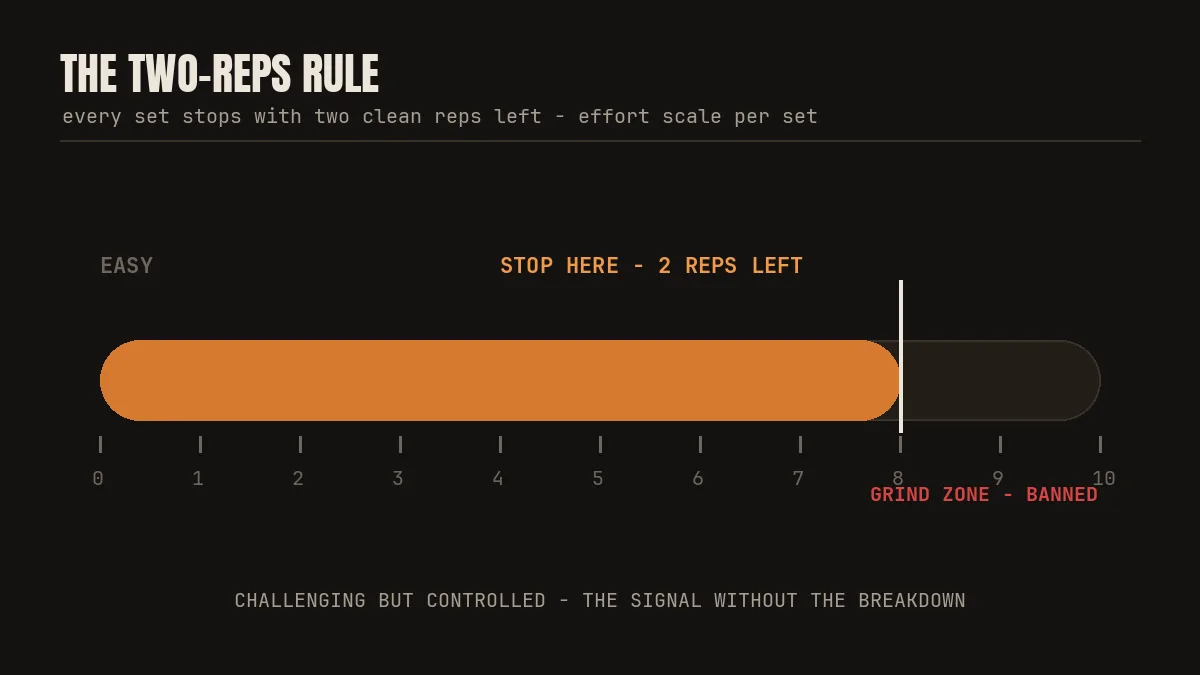
Think of it as an effort dial, not a switch. A set stopped with two clean reps left sits around an 8 out of 10: genuinely hard, fully under control, recoverable by tomorrow. The last two reps you skipped are the two that cost the most and buy the least.
A missed rep here is treated as a programming failure, not a badge. If you miss, the plan asked too much, and it adjusts. That inversion matters: the burden of getting the dose right is on the program, not on your willpower.
The research frame that settles it for most skeptics: sets taken close to failure and sets taken to failure produce nearly identical muscle growth, while the failure sets produce far more fatigue per unit of growth. You are not trading results for safety. You are declining a bad exchange rate.
Heavy-ish and crisp: what it feels like in practice
Every working set should feel like you owned it: the weight moves at a steady speed, your position never wobbles, and when you rack it you could have done two more clean reps. The effort is real. This is not a stroll. But it never turns ugly.
That standard does something unexpected: it makes progress measurable again. When every rep is clean, a small weight jump or an extra rep is a genuine gain, not a form breakdown you talked yourself into. The logbook stays honest, and honest logbooks are how the smallest jumps available (/blog/the-smallest-jumps-available) compound into real strength.
Men raised on grind culture usually need two or three weeks to trust this. Then the same thing always happens: they realize they are training more often, sore less, and the numbers are moving faster than they did when every session was a war. Hard is not the same as effective. Crisp is effective.
A useful self-test during any set: if you have to hold your breath through the hard part, if your face is doing work, if anyone watching could tell which rep was last - that was the last clean one, and the set should have ended there. Crisp is visible from the outside. Grind always is too.
The rules that replace the max test
You will never be asked for a one-rep max, and you will never see a percentage-of-max prescription. Weights are set by how the set should feel: challenging but controlled. Progress comes in the smallest jumps available, not in leaps.
Progress gets measured with safe strength checks every few weeks - real work sets at real weights, not all-out tests. The numbers will move. Not this week. Over months, which is the only timeline that matters after 45. The full system is in the strength check, not the max test (/blog/the-strength-check-not-the-max-test).
And when a rough week hits - bad sleep, work blows up, the body says no - the plan scales down instead of daring you to push through. Grinding through a rough week is exactly how a bad week becomes a bad quarter. That is the rough-week rule (/blog/the-rough-week-rule).
The objection: 'but I like pushing hard'
Fair. Some men genuinely enjoy the feeling of a maximal effort, and telling them to stop feels like being told to retire early. Two answers.
First, you still get to work hard. A set of eight at an 8-out-of-10 effort is hard work by any honest standard. What you give up is not effort. It is the slop: the ugly, formless, joint-grinding last two reps.
Second, decide what the training is for. If it is for a total at a meet, grind away and accept the bill. If it is for being strong and capable at 70, the long game is the whole game - and the long game is won by the man who never has to stop.
How the rule plays out across a real week
Monday's session: every set stops crisp, you finish in forty-five minutes feeling worked but upright. Tuesday: no soreness tax, normal life. Wednesday's session: same standard, weights a notch up where earned. By Friday you have trained three times and never once needed a recovery day, a painkiller, or a negotiation with yourself.
Now run the grind version: Monday is heroic, Tuesday is sore, Wednesday becomes 'I'll go Thursday,' Thursday is half-hearted because you are still tired, and Friday's session is skipped to start fresh Monday. The heroic week delivered fewer quality sets than the crisp week - and a worse mood about all of them.
The ego problem, and the reframe that fixes it
The hard part of this rule is not physical. It is the identity of being a man who leaves reps on the table, especially if your twenties were built on emptying the tank. The reframe: the two reps you leave are not weakness - they are a deposit slip. You are buying next week's session, next month's jump, next decade's training with them.
There is also a quiet satisfaction that replaces the grind high: the logbook that climbs without interruption. Men who switch report the same arc - suspicion for two weeks, then the realization that steady progress feels better than heroic suffering ever did. Watching the numbers rise month after month without a setback is its own drug, and it is the only one on offer with no side effects.
Where this rule came from
Stopping short of failure is not a concession invented for older men. It is how the strongest strength cultures actually trained: the old Soviet-influenced systems built careers on submaximal, high-quality practice, and modern research on effort proximity keeps confirming the same exchange rate - near-failure work buys the growth, failure work buys the fatigue.
The 25-year-old can afford to ignore the exchange rate for a while; youth subsidizes waste. After 45 the subsidy ends and the bill arrives itemized. The rule simply prices training honestly.
The recovery budget, itemized
After 45, recovery is a finite account that everything draws from: training, work stress, poor sleep, illness, and life generally. A grinding set is the single most expensive purchase in the training catalog - it spends recovery at several times the rate of a crisp set while buying almost no extra growth.
Run it like a budget and the rule prices itself. Three crisp sessions a week spend recovery at a rate the account replenishes. Add grinding to each and the account runs a deficit - which arrives as stalled lifts, flat energy, and eventually the injury or the quit. The two-reps rule is not caution. It is accounting.
What to do with the energy you did not spend
Men coming off grind culture often finish crisp sessions feeling like they left something on the table - a restlessness, a sense of not having earned the shower. Two honest answers.
First: that feeling fades within a few weeks, replaced by something better - the feeling of being able to train hard again tomorrow. Second: if energy genuinely remains, the program has places for it - an extra engine walk (/blog/cardio-without-the-punishment), an extra carry, one more clean set of an accessory. What it never has a place for is turning a controlled set into a grinder because the mood was good.
The ten-year ledger
Zoom all the way out and compare the two men at the end of a decade. The grinder's ten years: several forced layoffs, one or two real injuries, long flat stretches where training barely happened, and a relationship with the gym built on boom and guilt. The crisp man's ten years: no layoffs, no heroics, a logbook that never stopped climbing slowly.
The second man is not a little ahead. He is in a different category - still training, still progressing, with joints that still work, while the first man is telling people he used to lift. Every set stopped two reps short is a vote for the second man's ledger.
Do this today
Take your next set of anything - squats to a chair, pushups, a row with a bag - and stop it two clean reps before you have to. Rack it, stand there, and notice that you feel worked, not wrecked.
That feeling is the target. Every set, every session, every week. If you want a program that enforces it for you - weights set by feel, jumps kept small, rough weeks scaled automatically - start here (/guide).
Start your first two weeks this week.
Full workouts, check-ins, workouts that adjust to you. Free - no card required.
Start free