
Cardio without the punishment: the engine session
August 26, 2026

Ask a man over 45 about cardio and you get one of two answers: the guilt of not doing it, or the memory of doing it wrong - the New Year's runs that wrecked a knee, the spin class that felt like punishment, the burpees, the gasping, the quitting.
Both come from the same bad premise: that cardio is suffering you endure to offset food. It is not. Cardio, done right, is easy conditioning work that sits alongside the lifting and is pleasant enough to keep doing for years.
This program treats it that way: one or two easy engine sessions a week, done at a pace you can hold a conversation at, chosen from options a real life can sustain. No bootcamp. No punishment. Here is how it works and why easy beats heroic. One boundary: this is training, not medical advice. If you have a heart or blood pressure condition, or take medication, ask your doctor what effort is right for you.
The engine session, defined
An engine session is 20-40 minutes of movement at an effort where you can speak in full sentences but would rather not give a speech. Brisk walking, easy cycling, rowing, swimming, an inclined treadmill - the mode matters far less than the effort.
That conversational pace is not a cop-out. It is the intensity you can repeat every week and recover from alongside strength training, which is what makes it stick.
One to two of these a week, every week, is the entire prescription. It sounds too modest to matter. The arithmetic (/blog/two-days-done-beats-five-days-planned) says modest and repeated is what lasts.
Why easy beats heroic after 45
Hard cardio has a place - for young men with recovery to burn and no lifting program to protect. After 45, a weekly lung-buster does three things: it taxes the same recovery budget your strength training depends on, it leaves you flat for the next lifting day, and it is miserable enough that you will quit it by February.
Easy sessions do the opposite. They cost almost nothing to recover from, they can live on rest days, and, being genuinely pleasant, they survive. A habit you keep for ten years beats a habit you abandon in ten weeks by an infinite margin.
It also fits the rest of the plan: easy engine work sits alongside the lifting and the protein rule (/blog/protein-after-45-the-per-meal-rule) without competing with either. Heroic suffering does not.
There is a training point worth understanding, because it feels backwards: easy sessions are the ones you can stack week after week, and stacking is where conditioning comes from. Go harder and the session starts borrowing from the recovery your lifting needs. Easy is not the compromise. Easy is the target.
The four engine sessions that always work
The brisk walk. Outside if possible, with inclines if available, fast enough that conversation takes a little effort. The most underrated exercise in existence: zero skill, zero equipment, no gym required, and it scales from unfit to fit by speed and hills.
The easy bike. Stationary or real. No impact, easy to hold at conversational pace, and pairs well with a podcast. Twenty-five minutes at an effort you could double if chased.
The rower or the pool, for men who like a full-body option. Rowing rewards modest technique and punishes ego, so keep it genuinely easy. Swimming is the lowest-impact engine work there is, at the cost of needing a pool.
The ruck or weighted walk, for men who find plain walking too easy to respect. A light pack turns a walk into real work without turning it into running. Keep the weight modest; the point is duration, not load.
Where it fits in the week
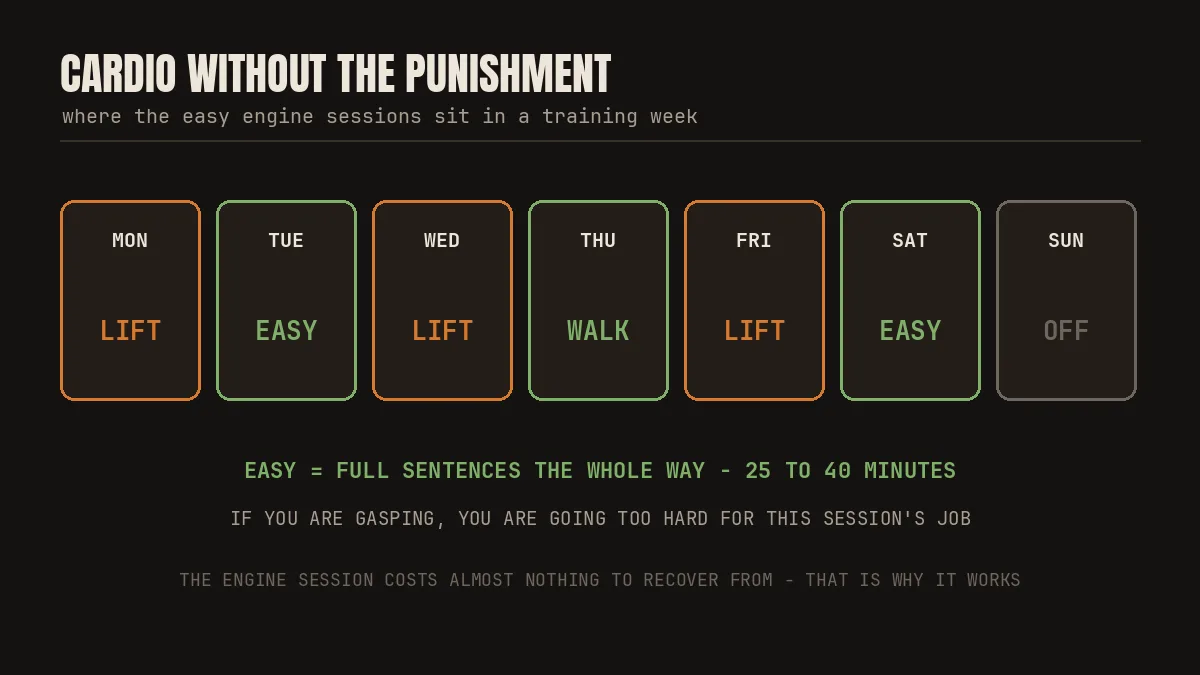
The default layout: strength days stay strength days, and one engine session lives on the weekend or a rest day. If the week gets crowded, the engine session is the first thing that flexes, not the lifting - the lifting runs on a progression schedule, while the engine tolerates a sliding appointment.
On rough weeks - the ones the check-in flags (/blog/the-rough-week-rule) - a gentle walk often survives when nothing else does, and it counts. The rule stays the same: less work, never more, and never zero if a walk is possible.
Two short sessions beat one long one if your schedule prefers it. The engine does not care about the calendar shape. It cares that the signal keeps arriving.
Travel weeks are where the walk proves its worth as the default engine session. Every hotel, every city, every schedule supports twenty minutes of brisk walking - no gym search, no pool hours, no bike rental. The habit that survives airports is the habit that survives years.
The talk test, calibrated
Men consistently overcook easy sessions because easy feels like cheating. The calibration: at the right effort, you can speak a full sentence - eleven or twelve words - without gasping, but singing would be impossible. If you could comfortably chat the whole way, speed up slightly. If sentences break into fragments, back off.
Breathing through the nose works as a cheap governor: if you can keep nasal breathing the whole session, you are in the right zone. The moment the mouth has to open, the effort has drifted above easy. Use either test every few minutes until the pace becomes instinct - it takes most men three or four sessions.
What the engine work is not for
It is not fat-burning punishment. It is not a calorie-erase for weekend eating - that math never works at any age. And it is not cardio for its own sake, the badge-collecting variety that turns into mileage competitions.
It is conditioning work that supports the rest of the program. Framed that way, twenty-five easy minutes twice a week is one of the best deals in the plan - less time than one strength session, and easy to keep.
The two-session upgrade, when life allows
One engine session a week is the floor and it is enough to matter. Two is the upgrade, and the second session is where variety earns its place: one walk or ruck, one bike or row, different days. Variety is not for muscles - it is for the calendar and the mind, so the habit never depends on one piece of equipment or one weather window.
If a third session tempts you, the honest answer is: fine, as long as it stays easy and the lifting stays crisp. Engine work that starts interfering with strength recovery has stopped being easy by definition, whatever the speedometer says.
The scoreboard for engine work
If you want one number to watch as the engine work accumulates, use the session itself: the same route or machine at the same talk-test effort. Most men find that over the first months the pace at that effort creeps up, or the hills feel less like an event. That is conditioning, made visible for free.
Log it the way you log lifts: date, route or machine, time, and how it felt. The trend over a season is the point, not any single day.
Walking: the engine session disguised as life
The walk deserves its own defense because men underrate it precisely because it is easy. A brisk daily walk is easy conditioning, a gentle way to move on the days between lifting sessions, and - not trivially - the thinking time most men no longer get anywhere else.
It also scales perfectly with age in a way running does not. The walk you take at 47 works identically at 67. Build the habit around it now - after dinner, before work, calls taken on foot - and you have installed an engine practice with a forty-year service life.
When harder cardio earns its place
Honesty requires the exception: once the base is real - months of lifting plus regular easy sessions - a man who wants to can add short, sharper efforts. A few brisk hill repeats at the end of a walk, a harder row now and then. The base makes these tolerable; the recovery rules still apply.
The order matters and is not reversible: easy base first, sharp efforts later, and always optional. The men who burn out are the ones who skip the base and go straight to heroic. The program's sequence exists so you never have to learn that the hard way.
The engine and the account: how they split the work
It helps to be precise about what each piece of the program owns. Strength training builds strength: legs, back, grip, the weights in the logbook. The engine sessions build conditioning: the ability to walk, ride or row for half an hour and feel good doing it.
Neither substitutes for the other, and the amounts are deliberately asymmetric - the lifting carries most of the weekly minutes because most of what men over 45 come here for lives there. But the engine session, modest as it is, never gets cut from the template. Small dose, non-negotiable.
Do this today
Go for a 20-minute walk at a pace that makes conversation slightly effortful. Notice that you come back feeling better than you left. That feeling is the entire marketing department of easy cardio.
Then put the second one on the calendar: a specific day, a specific time. The engine, like the account, compounds on schedule. The full week's layout - lifting days, engine days, and how the plan flexes around your life - is in the guide (/guide).
Start your first two weeks this week.
Full workouts, check-ins, workouts that adjust to you. Free - no card required.
Start free