
Protein after 45: the per-meal rule most men miss
August 19, 2026

Most protein advice is written for 25-year-old bodybuilders and delivered as a daily number: eat X grams per day, from a tub, forever. Men over 45 hear it, try it for a week, and quit, because it ignores how they actually eat.
The program's approach is simpler: instead of a daily number, plan protein into each main meal you already eat. It is a planning habit, not a diet, and it fits around real life.
This post is the rule, the plate version of it, and the tracking approach that does not turn eating into homework. One boundary: this is training-plan guidance, not medical or dietary advice. If you have a kidney or other health condition, or take medication, your doctor or a registered dietitian sets your numbers.
The rule: 30-40 grams per meal
At each main meal, eat 30 to 40 grams of protein. Not 10 at breakfast and a rescue mission at dinner: a full dose, each time, at the meals you already eat.
Why per meal? Because a meal is a unit you already plan. Deciding once what each breakfast, lunch and dinner looks like is far easier than chasing a daily total at 9 p.m.
Three meals at that dose lands most men in the right total range without ever counting a daily number. The meal is the unit. The day takes care of itself.
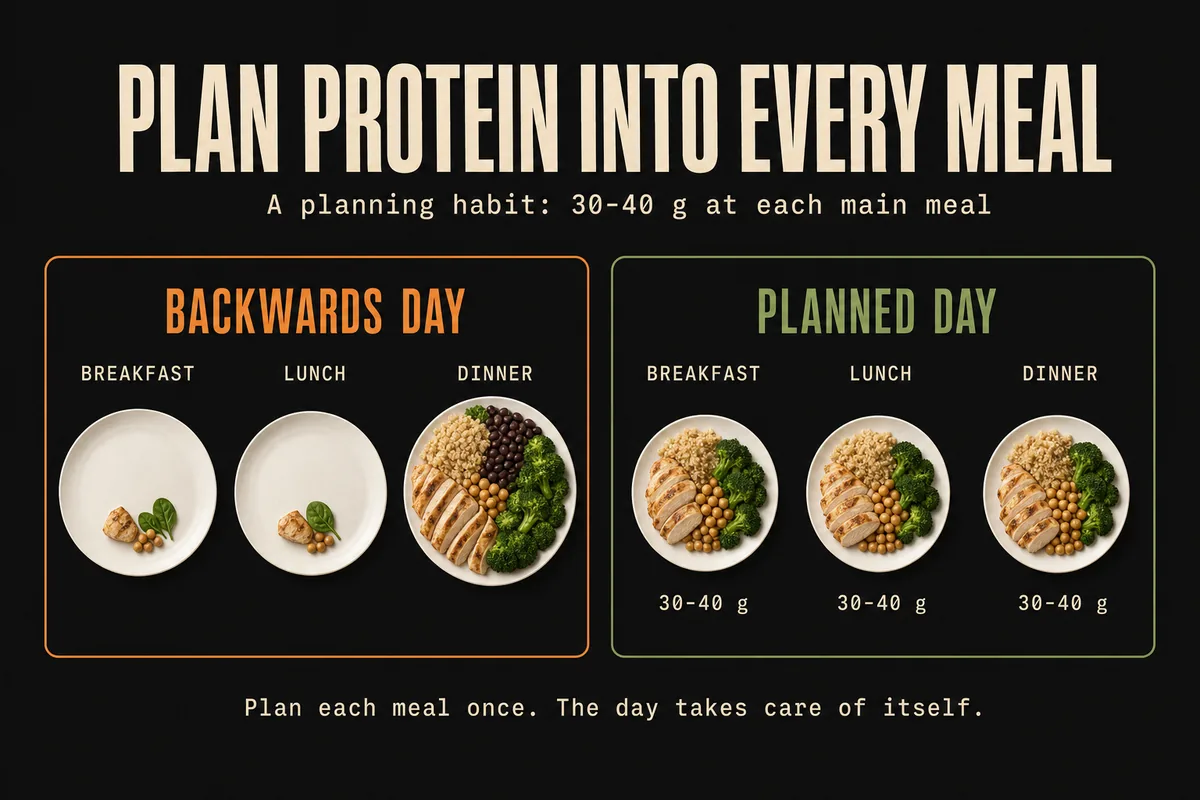
Why the full dose at each meal
The classic pattern looks like this: coffee and toast for breakfast, a sandwich at lunch, then a big dinner. Two of the three meals carry very little protein, so the day leans on dinner to do everything, and dinner rarely can.
Planning each meal at the guideline fixes that without counting a daily total. And protein is only half of the plan: training is the work, and the meals are part of planning around it. The program asks about both at check-in because they are designed together.
What 30-40 grams looks like on an actual plate
No scale required. A palm-and-a-half of meat, fish, or poultry is roughly there. Four eggs, or two eggs plus Greek yogurt. A large chicken breast. A generous piece of salmon. Two scoops of cottage cheese with fruit if that is your speed.
The useful habit is learning your three or four default anchors - the breakfasts and lunches you actually repeat - and fixing each one at the full dose once. After that, the rule runs on autopilot.
Plant-based men hit the same numbers with combinations: tofu plus edamame, lentils plus yogurt, beans plus eggs. It takes slightly more plate planning and is entirely doable.
The foods that do not work as anchors, for calibration: toast, cereal, oatmeal alone, a plain salad, fruit, most bars, and anything whose first ingredient is flour. These are fine foods with the wrong job description. The anchor has to be protein-dense by nature - eggs, dairy, meat, fish, tofu, legumes in real quantities.
The three-meal template that works
Breakfast is the highest-leverage fix because it is usually the worst offender. Swap the toast-first pattern for an eggs-or-yogurt-first pattern and you have fixed a third of your day in one move.
Lunch is the anchor: build it around the protein, not around the bread. The sandwich is fine - double the filling. The salad is fine - the chicken on it should be the point, not a garnish.
Dinner is usually already close. The common gap is distribution, not amount, so dinner mostly needs no change once breakfast and lunch carry their share. Full food lists and meal patterns live in the nutrition guide (/nutrition).
A word on snacks: they are not required. Three anchored meals cover the rule, and for most men over 45 a snack habit is where the anchors get crowded out. If the day is long and dinner is late, a yogurt or a shake bridges it - but the bridge is optional, the anchors are not.
Tracked like training, not like dieting
The program's check-in asks about protein the same way it asks about sleep: a quick daily rating, not a calorie log. Did your meals carry the dose? Yes or mostly or no.
That is deliberate. Weighing food works for about three weeks and then becomes the reason men quit the whole project. A rating keeps the habit honest without making eating a second job - and when the rating trends down, a coach sees it alongside your sleep and training trends and says something.
The goal is boring consistency: the same three or four anchors, repeated, week after week. Boring is what compounds. Variety is a garnish.
The backwards day, and how to flip it
Here is the pattern that breaks most men over 45: coffee and toast for breakfast (maybe 5 grams), a sandwich at lunch (maybe 15), then a proper dinner (40 or more). The daily total is not terrible. The distribution is - two of the day's three meals carry almost none of it, and dinner is left doing all the work.
The flip is not more food, it is redistribution. Move thirty grams into breakfast - eggs, yogurt, or last night's protein reappearing - and the day goes from one anchored meal to two. Fix lunch's anchor and you are at three. Many men also find a fuller breakfast makes the 4 p.m. pantry raid less tempting.
Men notice the flip within a week, not because muscle appears, but because hunger patterns change. A full-dose breakfast quietly rearranges the whole day.
Protein and the training: how the pair actually works
Think of training as the work and the meals as part of planning around it. The program treats them as one plan, not a workout plus a separate diet project.
Over a week, the pattern looks like this: the sessions happen on schedule, each anchored meal is planned ahead, and sleep (/blog/sleep-drives-the-program) gets defended like an appointment. The check-in asks about all three because they move together, and when one slips, the plan adjusts the training rather than piling on rules.
The shake question, answered plainly
Powder is food, not magic, and not cheating. A scoop of whey is roughly 20-25 grams of protein for the effort of stirring - useful when a meal will be late, when breakfast appetite is low, or when travel makes anchors impossible. Two scoops with milk lands a full dose.
What powder is not: a replacement for the anchored meals. Men who start shakes often start skipping real protein at meals, which trades a habit that also delivers a real meal and satisfaction for a glass that is gone in ninety seconds. Use powder to patch the gaps, never to replace the anchors.
If you buy one: plain whey or a plant blend, short ingredient list, no proprietary muscle matrix nonsense. The expensive tubs are marketing; the protein is the same.
Eating out, travel, and other real life
The rule survives restaurants better than diets do, because the move is structural: order around the protein, not around the side. Double the main, skip the filler, and most restaurant meals hit the guideline without a scene. Steakhouses, grills, diners with eggs - the modern world is accidentally well-equipped for this rule.
Travel is the honest test. Airport and hotel food defaults to the backwards day - pastries at breakfast, a sad sandwich at lunch. The counter-moves: yogurt and eggs wherever breakfast happens, a grocery stop on arrival for jerky or cottage cheese, and the shake you packed. Two anchored meals out of three keeps the week intact.
And when a day simply goes sideways - wedding, flight chaos, holiday - the rule forgives. One under-dosed day changes nothing. The streak resumes at the next meal, not next Monday.
Protein quality and the plant question
Animal proteins carry the full amino-acid package in dense form, which is why they anchor so easily. Plant proteins work but need more deliberate combining and slightly larger servings - lentils plus yogurt, tofu plus edamame, beans plus eggs if you eat them.
The plant-based man over 45 can hit the guideline at every meal; he just cannot hit it accidentally. Where the omnivore's default plate often clears 30 grams without thought, the plant plate needs the protein chosen first and built around. Same rule, more intention.
Timing around training: simpler than the forums say
The internet's protein-timing anxiety - the 30-minute window, the exact pre-bed shake protocol - is noise for men training two to four times a week. The plan asks for a steady amount at each meal across the day, not a stopwatch.
The practical version: train whenever fits, and let the next anchored meal follow. If the session lands long before a meal, a shake bridges it. That is the entire timing protocol. The men who need more precision than that are being paid to compete, which is not us.
The first week on the rule, day by day
Day one: fix breakfast only. Eggs or yogurt, thirty grams, done. Notice the 11 a.m. hunger is quieter.
Day two: same breakfast, plus order lunch around the protein. Notice the 4 p.m. version of the same effect.
Day three onward: both anchors hold while dinner mostly takes care of itself - it usually already clears the bar. By the end of the week the rule is running on three defaults and zero counting.
That is the whole installation. The rest of the refinement - food lists, meal patterns, eating out - lives in the nutrition guide (/nutrition).
The weekly protein rhythm that runs itself
The rule becomes permanent when it attaches to a small rotation instead of daily decisions. The pattern that works: two or three default breakfasts rotated without thought (eggs one way, eggs another, yogurt bowl), two or three default lunches (the doubled-filling sandwich, the protein-anchored salad, leftovers done right), and dinners built around whatever protein is on the table.
Shopping follows the rotation: the protein anchors go on the list first, every week, same items. Men resist this because it sounds monotonous; in practice it is liberating. The decision fatigue that kills eating habits lives in variety-chasing, not in repetition. Save variety for dinners and weekends.
Within a month the rotation is invisible - it is just how you eat - and the guideline gets met three times a day by habit. That is the entire endgame of the rule: not tracking, not discipline, just defaults that do the work.
The numbers on an ordinary day
Make the dose concrete with an ordinary anchored day. Breakfast: three eggs and a yogurt - about 30 grams. Lunch: a chicken salad built around the chicken - about 35. Dinner: a palm-and-a-half of fish with the usual sides - about 40. Total: 105 grams across three meals, every one of them at the guideline, zero counting performed beyond learning the anchors once.
Compare the backwards day: toast and coffee (5), a sandwich (15), a big dinner (40) - total 60, with only one meal at the guideline. The anchored day delivers more protein, spread across three meals; the backwards day delivers less, packed into one. Same man, same appetite, different defaults.
Age 60, 70, and beyond: the rule doesn't change
The rule itself never changes with the decades: plan protein into each main meal, every day. Install the habit now and it is already there later.
If your doctor or a registered dietitian has given you different numbers, theirs win. The plan's job is the habit, not the prescription.
The objections, answered
I am not hungry in the morning: then the breakfast anchor starts as yogurt or a shake and grows - most men find a morning appetite shows up within a couple of weeks of eating breakfast regularly.
It is expensive: eggs, Greek yogurt, cottage cheese, tinned fish, and lentils are among the cheapest protein on the shelf. The rule raises the grocery bill far less than the snack habit it quietly deletes.
I already eat plenty of protein: the check that settles it is the meal audit, not the daily guess - most men who say this are running the backwards day: a real dinner and two under-dosed meals. Plenty at dinner is not plenty per meal.
It sounds like bodybuilder food: it is the opposite - ordinary food, portioned by a rule, eaten at a normal table. Nothing about the anchored plate looks unusual to anyone watching.
And the deepest objection, usually unspoken: it sounds too small to matter. Thirty grams at breakfast cannot possibly change anything. Run it for a month and watch the meals stop being a daily decision - the anchors are just there, three times a day, and the check-in stops nagging. Small rules, kept daily, are the only kind that stick after 45. This is one of them.
Do this today
Score your last three days: how many meals hit 30-40 grams? If the answer is one a day, you have found the cheapest upgrade available to you.
Fix breakfast first. Tomorrow morning, before the toast or instead of it: eggs, yogurt, or leftovers. One meal, one day. Then let the guide (/guide) and the nutrition page (/nutrition) handle the rest.
Start your first two weeks this week.
Full workouts, check-ins, workouts that adjust to you. Free - no card required.
Start free