
Bone density after 45: lifting, plus a 90-second habit
August 12, 2026
The letter arrives after a routine scan, or worse, after a fracture that should not have happened: bone density is down. For men over 45 it feels like a women's health issue that somehow landed on the wrong desk. It is not. Men account for roughly one in three hip fractures, and men do worse after them than women do.
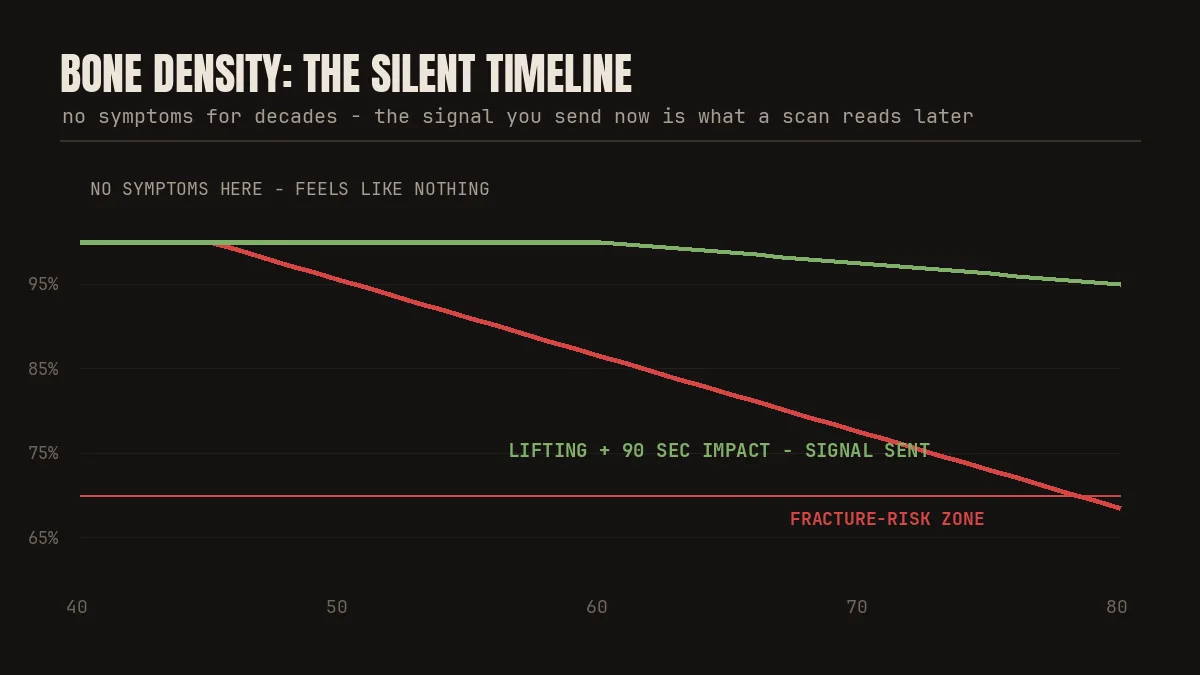
Bone does not send warning pains the way a knee does. It thins quietly for years, and the first announcement is often the fracture itself. That is the bad news. The good news is unusually good: bone responds to training faster and more reliably than almost any tissue in the body, and the dose it needs is small.
This post covers why bone is silent until it is not, what actually builds it, and the 90-second habit that covers the gap your workouts miss.
Why the first warning is usually a fracture
Muscle complains as it weakens: stairs get harder, the bag feels heavier, getting off the floor takes planning. Bone does none of that. It loses density in complete silence, at roughly the same schedule as muscle after 45, until one day a fall from standing height breaks a wrist or a hip that should have shrugged it off.
The stakes are not abstract. A hip fracture after 65 is one of the most dangerous events in men's health: a large share of men never return to their previous independence. The fracture is the announcement, not the beginning. The loss started a decade earlier.
And the standard advice - take calcium, drink milk - barely moves it. Bone is not short of minerals. It is short of a reason to keep them. That reason is mechanical load, and it is the one input almost no man over 45 is deliberately giving it.
The screening gap makes it worse. Women over 65 get routine bone scans; men rarely do unless a fracture or a specific risk factor forces the question. Most men over 45 simply do not know their bone status - the account balance is unknown, and the default assumption that it is fine is made with no evidence.
What bones actually respond to
Bone is living tissue that remodels constantly, and it follows one rule: it keeps the density that current loading demands, and it sheds the rest. Load it and it reinforces. Stop loading it and it quietly dissolves the surplus it no longer needs.
The signal it reads best is forceful muscle pull and impact: the kind produced by lifting weights and by short, sharp ground contact. Swimming and cycling, for all their virtues, barely register. Long walks help a little. Lifting helps a lot.
This is the same deposit logic as muscle - bone and muscle are paid in the same workout, which is why strength training is the retirement account (/blog/muscle-is-the-retirement-account) for both. But there is one gap: the spine and hips respond best to brief, daily loading, and most men train two to four days a week. That gap is what the 90 seconds covers.
The site-specificity matters: bone reinforces where it is loaded. Leg strength alone does not fully protect the spine and wrist; that is why the program's patterns - squats, hinges, loaded carries, pressing - are chosen to load the skeleton broadly, and why the 90-second habit targets the hips and spine directly.
The 90-second addition
Once a day, on any day, including rest days: a short burst of deliberate impact. The research-backed version is simple - small jumps, done briefly and consistently. Not box jumps, not anything athletic. Step off a low step and land tall, or do a few gentle two-foot hops in place. Thirty to fifty contacts, a minute and a half, done.
The mechanism is the sharpness of the signal, not the volume. Bone responds to unusual, brief loading spikes far better than to long, gentle repetition. A 90-second daily spike tells your hips and spine, every single day, that density is still required.
If jumping is off the table - knees that object, or a diagnosis already in hand - the alternative is brisk heel drops: rise onto your toes and let your heels land firmly, or march hard in place. Firm contact, tall posture, brief. Your doctor's guidance beats this article if you already have osteoporosis.
The 90 seconds, exactly
Pick one: ten small two-foot hops, or ten step-offs from a bottom stair, landing quietly and tall. Rest a few seconds between contacts - bone responds better to separated spikes than to a blur.
Do three rounds. Total time, including the rests, is about 90 seconds. Do it in the kitchen while the kettle heats. Shoes optional, enthusiasm optional, consistency not optional.
Land like you mean it but not like you are angry: stiff and tall, not collapsing, not stomping. If anything hurts in a sharp or alarming way, stop and switch to the heel-drop version.
Where to start, depending on where you stand
No diagnosis, no scan, just a man over 45: start the habit now and let the lifting handle the heavy signal. Prevention is enormously easier than reversal.
A scan already flagged low density: strength training becomes non-negotiable, the 90 seconds becomes daily, and your doctor joins the conversation about whether medication belongs alongside. Training and medical care are complements here, not rivals.
Already training but never thought about bone: you are most of the way there. Add the daily spike for the spine and hips, and check that your program includes loaded carries and squats - the patterns with the strongest bone evidence. The program's joint-friendly versions are in the guide (/guide).
Slow is not nothing
Bone remodels on a months-long clock, slower than muscle. You will not feel anything happening, which is exactly why people quit bone habits. Judge it the way you judge the retirement account: not by the daily balance, but by the direction over years.
The man who starts at 48 does not notice anything at 49. At 58, when a fall on ice breaks someone else's wrist and only bruises his, he notices. That is the whole game, and it costs 90 seconds.
The muscle-bone partnership
Muscle and bone are not two projects - they are one system with two materials. Every time a muscle pulls hard against a weight, it loads the bone it is anchored to, and bone interprets that pull as the instruction to stay dense. This is why strength training is the single intervention that pays both accounts at once (/blog/muscle-is-the-retirement-account).
It also explains the failure mode of weight loss without training: lose weight by diet alone and some of what leaves is bone, because the skeleton is being asked to carry less and responds by keeping less. Men over 45 who diet without lifting are quietly trading bone for a smaller number on the scale. Training during any weight change is what keeps the bone account funded.
The fall is the real enemy
Bone density gets the attention, but the event that does the damage is the fall - and falls are a strength and balance problem as much as a bone problem. Strong legs catch stumbles. Practiced movement patterns keep footing. The carry and squat patterns in the program are, among other things, fall insurance.
The complete picture of protection is therefore three layers: keep bone dense (lifting plus the 90 seconds), keep the muscles that catch you strong (the program), and keep the balance sharp (the same training, since loaded standing work is balance practice in disguise). Dense bone in a man who falls weekly is a wager. All three layers are the hedge.
If the scan already happened
A low reading is not a verdict - it is a starting balance, and the response is the same three layers applied more deliberately. The training stays, the daily 90 seconds becomes non-negotiable, and your doctor decides whether medication joins the team. The research is clear that loading still matters alongside medication, not instead of it.
The one adjustment: jump-based habits get replaced with the heel-drop version until your doctor clears impact, and any exercise involving loaded spinal rounding gets swapped - exactly the kind of substitution the program's joint-friendly system (/blog/joint-friendly-is-a-design-choice) exists to make.
The scan conversation to have with your doctor
Most men over 45 have never had a bone-density scan and will not be offered one routinely. That does not mean the question is closed. If you have the risk factors - a previous low-impact fracture, long-term steroid use, heavy alcohol history, a parent with hip fractures, or simply a frame that has been shrinking - ask directly. The scan is quick, cheap, and definitive.
If the answer comes back low, it changes tactics, not strategy: the loading program stays, the daily habit becomes mandatory, and your doctor decides whether medication joins the effort. If it comes back normal, you now have a baseline - and a number to beat at the next check.
Either way, the worst position is the default one: not knowing. Bone does not announce itself, so the men who ask are the ones who get to act early, when action is cheapest.
Nutrition's supporting role
Loading is the signal, but bone also needs raw material - and here the standard advice is partly right. Calcium matters, and most men get enough from food: dairy, tinned fish with bones, leafy greens, tofu. Vitamin D matters more than most men realize, because it governs calcium absorption - and deficiency is common in men over 45, especially through northern winters. It is one of the few supplements with real evidence behind it, and the nutrition guide (/nutrition) covers the doses and the lab conversation.
What does not move bone: calcium megadoses without the loading signal. The body does not store what it is not being asked to use. Signal first, material second, and the pair is covered between the training, the 90 seconds, and an ordinary decent diet.
Ninety seconds, one year later
Zoom out on the habit's economics. Ninety seconds a day is about nine hours across an entire year - less than a single weekend - spent on the one tissue in your body that silently determines whether your 70s are independent or fragile. There is no other health investment with that ratio.
And the habit scales with everything else in this program: same philosophy as the smallest jumps (/blog/the-smallest-jumps-available) and the two-day week (/blog/two-days-done-beats-five-days-planned). Tiny, sustainable, compounding. The bone account, like the muscle account (/blog/muscle-is-the-retirement-account), is won by deposits so small you cannot fail at them.
Why this habit and not another
Of everything in this program, the 90 seconds is the easiest to skip because it feels like nothing - no sweat, no soreness, no proof. That is exactly why it needs the trigger and the streak. Treat it like brushing teeth: not a workout, not negotiable, attached to something that already happens daily.
The men who keep it for years are never the ones with the best intentions. They are the ones who picked a trigger on day one - the kettle, the coffee, the toothbrush - and let the anchor do the remembering. Bone keeps what daily life demands of it. The habit exists to make the demand daily.
Do this today
Do the first round right now: ten small hops or ten step-offs, tall and quiet. Congratulations - your skeleton has received its first deposit of the day.
Then set the trigger: kettle, coffee, or the moment you brush your teeth. Bone habits die without a trigger. The lifting side of the equation - the squats, hinges, and carries that do the heavy work - is laid out in the complete guide (/guide).
Start your first two weeks this week.
Full workouts, check-ins, workouts that adjust to you. Free - no card required.
Start free